Your visit to Old York begins at the Museum Center located at the corner of York Street and Lindsay Road. The complex—which hosts educational and public programs throughout the year—includes visitor reception, the Virginia Weare Parsons Education Center and Program Room, the Remick Gallery, Jefferds Tavern, and York Corner Schoolhouse.
Remick Gallery
Named for a family of farmers from Eliot, Maine, whose barn beams are preserved in the structure, the Remick Gallery is Old York’s main gallery. The gallery features an installation including the finest objects in the museum’s collection, as well as artistic and historical objects of regional interest. This season it features several objects that highlight the impact of, and life during, the Revolutionary War in York.
Jefferds Tavern
Built in 1750 in Wells, Maine, just north of York, Jefferds Tavern was originally located on the King’s Highway, a stage and mail route between Portsmouth and Portland. In 1941 the building was moved to York and restored to create an idealized version of a true colonial tavern. Today the building is used year round as a museum program center, and events venue.
York Corner Schoolhouse
The York Corner Schoolhouse is one of the earliest surviving 18th-century schoolhouses in New England. Built in 1745 at York Corner near Route 1 (about one mile from its current location), it was used for more than a hundred years. The schoolhouse was moved to the current site at 3 Lindsay Road in the 1930s to become part of Old York. Today it is used for educational programs.
The Old Gaol
This National Historic Landmark sits atop York’s Gaol Hill, where colonial Maine’s first prison was constructed in 1656. The site was occupied continuously until 1860—first by Province of Maine’s correctional facility, and then by York County’s. Originally comprised of free-standing structures, the existing building reflects two centuries of construction campaigns.
For more than 250 years, the Emerson-Wilcox House served as a general store, stage tavern, tailor shop, post office, and home. The dwelling is typical of the vernacular Georgian architecture of Southern Maine. Built about 1735 by George Ingraham, the small center chimney house consisted of a parlor, hall, and two bedchambers. The subsequent owner, Edward Emerson, expanded the house in 1760, by moving an earlier structure (dating to 1710) from elsewhere in town. This created the “L” shaped building seen today. A final addition in 1817 brought the total number of rooms to fifteen. The house was damaged by a car crash in May 2021 that severely compromised the ground floor. Now repaired, the house is empty, pending funding to create exhibition space for Old York’s maritime collection.
Perkins House Museum and Administration
Originally the home of ferrymen and sea captains, the Perkins House Museum is a rambling, gabled structure situated on the York River by Sewall’s Bridge. In 1898, it became the summer home of Mary Perkins and her daughter, Elizabeth, who transformed the house into an environment evocative of colonial New England. The museum preserves the Perkins Family’s original interiors and possessions, and the historic section of the house is open for guided tours from June through October. Tickets available HERE.
The service wing of the building is home to Old York’s administrative offices.
Donnell-Hancock Warehouse
Built in the 1740s by John Donnell, ferry owner and chair maker, this is the last remaining commercial building on the York River from the Colonial period. It warehoused goods being shipped between York and the West Indies, and the rest of the world. John Hancock, signer of the Declaration of Independence, acquired an interest in the property in 1787 when the York River was the town’s major “highway” and shipping center.
George Marshall Store
In 1867, York businessman George Marshall purchased the Hancock-Donnell Warehouse and surrounding land on the York River. Adjacent to the warehouse, he built a store, where he sold general merchandise as well as wood, building materials, and coal. The store remained in the Marshall family until 1954. In the years following it served as home to the York Art Association, a gift shop, and the offices and research library for the Old York Historical Society. The space was revived in 1996 by curator Mary Harding, who opened a contemporary art gallery. The gallery currently is directed by Kate Rasche. For more information, click HERE.
Research Center at Beech Ridge
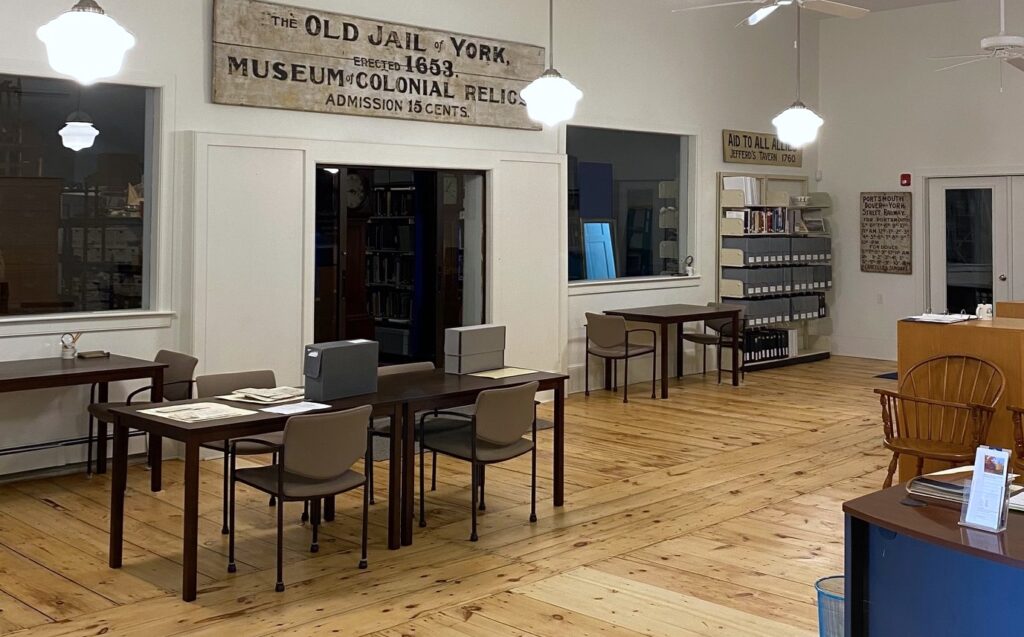
The Research Center, which houses Old York’s archive collection, reading room, and storage for object collections, is located in a former church on Beech Ridge Road in York. The original church building was built in 1867 as the York and Kittery Christian Society. By the 1920s however, the congregation’s numbers had dwindled. The building later was used by Pentecostal and Assemblies of God congregations, and in 1985, a large new sanctuary and fellowship hall were constructed to the southeast of the original structure. The archive collection and reading room are housed in the original 1867 building, and object collections storage is located in the later additions.